Why we're doing RITUAL
a few honest words on our RITUAL event, why it took us a while to feel we could, and why we love it…
RITUAL is different from our usual events. After ten years of gathering in the dark - all those costumes, all that music, all that beautiful chaos - we're holding a six-hour event in the afternoon with no rave, no substances, and almost no talking.
We hesitated over it for a while thinking who are we to hold a ritual? It's a big, loaded, almost sacred word, and attaching it to an event we were running felt a little presumptuous. But the longer we sat with that, the more we realised that the things RITUAL is actually made of - chanting, dancing, being held, moving as one - are exactly the things we love most. The ones that have touched us deepest across all these years. We've simply never given them a space entirely their own. That's what this is.
A new space for us to explore, connect and transform together.
We’ve long been inspired by two core ideas:
The first is collective effervescence - Durkheim's phrase, from over a hundred years ago, for what happens when people gathered around something they hold sacred start to fuse emotionally. The edges between individuals blur. Durkheim reckoned this was where religion actually came from: not belief first and feeling second, but the electricity of the gathered group first, with the gods arriving afterwards to explain it.
The second is communitas - the anthropologist Victor Turner's word for the fierce, levelling closeness that springs up when a group steps outside its normal roles and ranks together, into a kind of in-between space where, for a while, everyone is just a person among people. It doesn't last. That's part of what makes it precious.
These states already happen at our big events. But a festival is, by design, a thousand things at once. It's gorgeously overstimulating, and everyone's quite rightly off on their own adventure - the dancefloor, the outfit, the flirtation, the wander. The whole room never quite breathes together.
We started to wonder what would happen if we built a space that did nothing else. No competing attractions, no side-quests - just one arc, everybody pointed the same way for six hours, from high noon to dusk.
Why now: the sun, and what comes after
We're holding it near the summer solstice on purpose. There's something about the longest day - the sun at its absolute peak, right before it starts the long slide back into darkness - that felt worth marking. So RITUAL is a sun event. We're honouring Helios and Apollo at the height of their powers, while knowing the light's about to turn.
RITUAL the overture to Bacchanal, our Feast of Dionysus this September. Apollo falls; Dionysus rises. We move from the clarity of midsummer towards the wilder, darker release of autumn. (Dionysus, long before he was the god of wine, was the god of theatre and transformation - the god of the gap between who you are and who you might become. That gap is more or less where this whole event lives.)
The three things we'll actually do
The day moves through three doorways: voice, body and touch.
VOICE
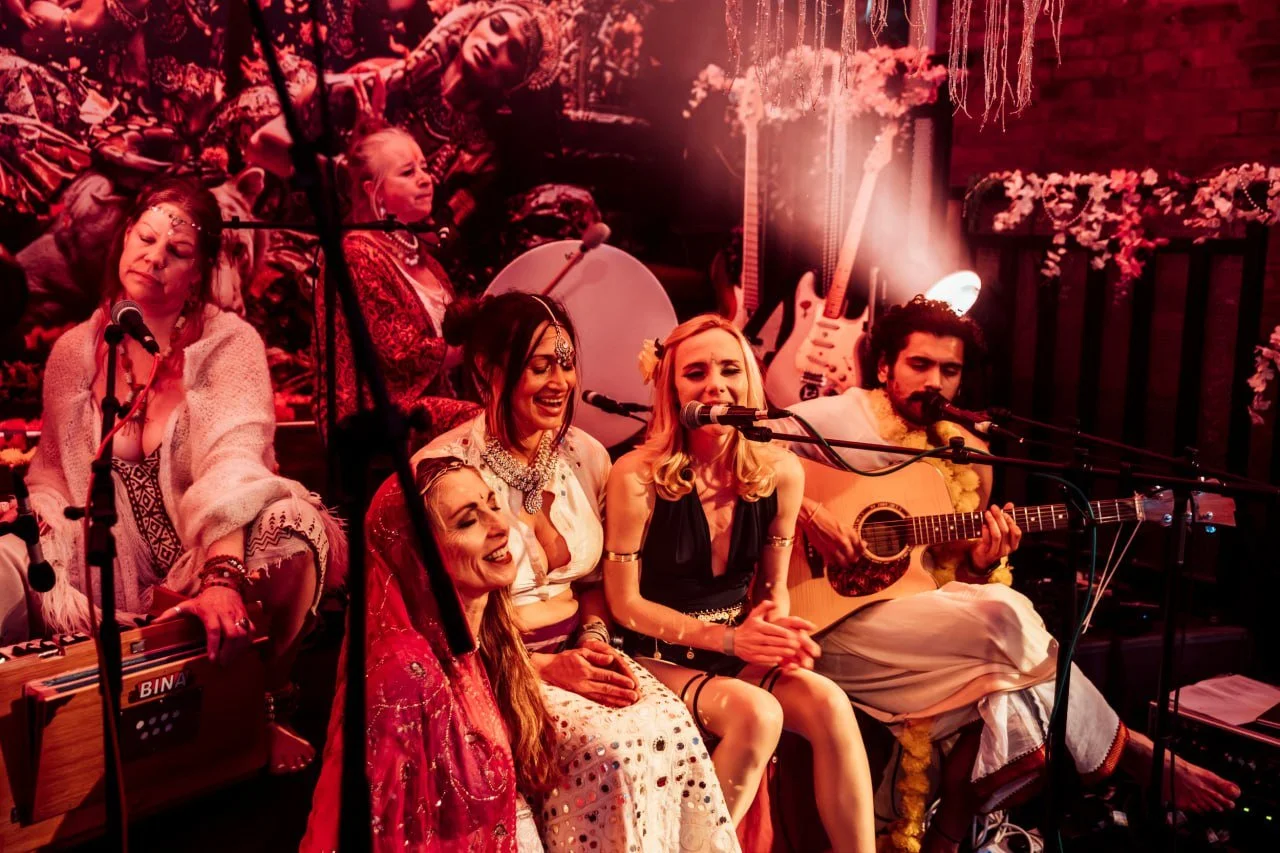
We begin with sound, led by Yush, who held the kirtan in the live music room at Shakti Rising and quietly undid a lot of us in the process. This bit isn't really about singing well - it's about vibrating together, letting everyone's breath and tone line up until the room turns into one big resonant instrument.
A 2015 study out of Oxford (Pearce, Launay and Dunbar, in Royal Society Open Science) found that singing bonds a group of strangers faster than other shared activities - they nicknamed it the "ice-breaker effect", because it connects a whole roomful of people at once without anyone having to actually get to know each other first. And it reaches right down into the body: researchers in Gothenburg found that when people sing slowly and in unison, their breathing falls into step and their heartbeats start to synchronise - the song basically conducting everyone's pulse.
BODY
Anyone who's been to a Fox&Badge night knows dance is our mother tongue - it's always been our surest way out of ourselves. We're not leaving it behind for RITUAL; we're trying to go further into it. The difference is the container. Our dancefloors are usually a glorious mess of stimulation, and here the movement sits inside something sober, silent and focused, which we think lets it do something it rarely gets the chance to. Less show, more surrender.
TOUCH
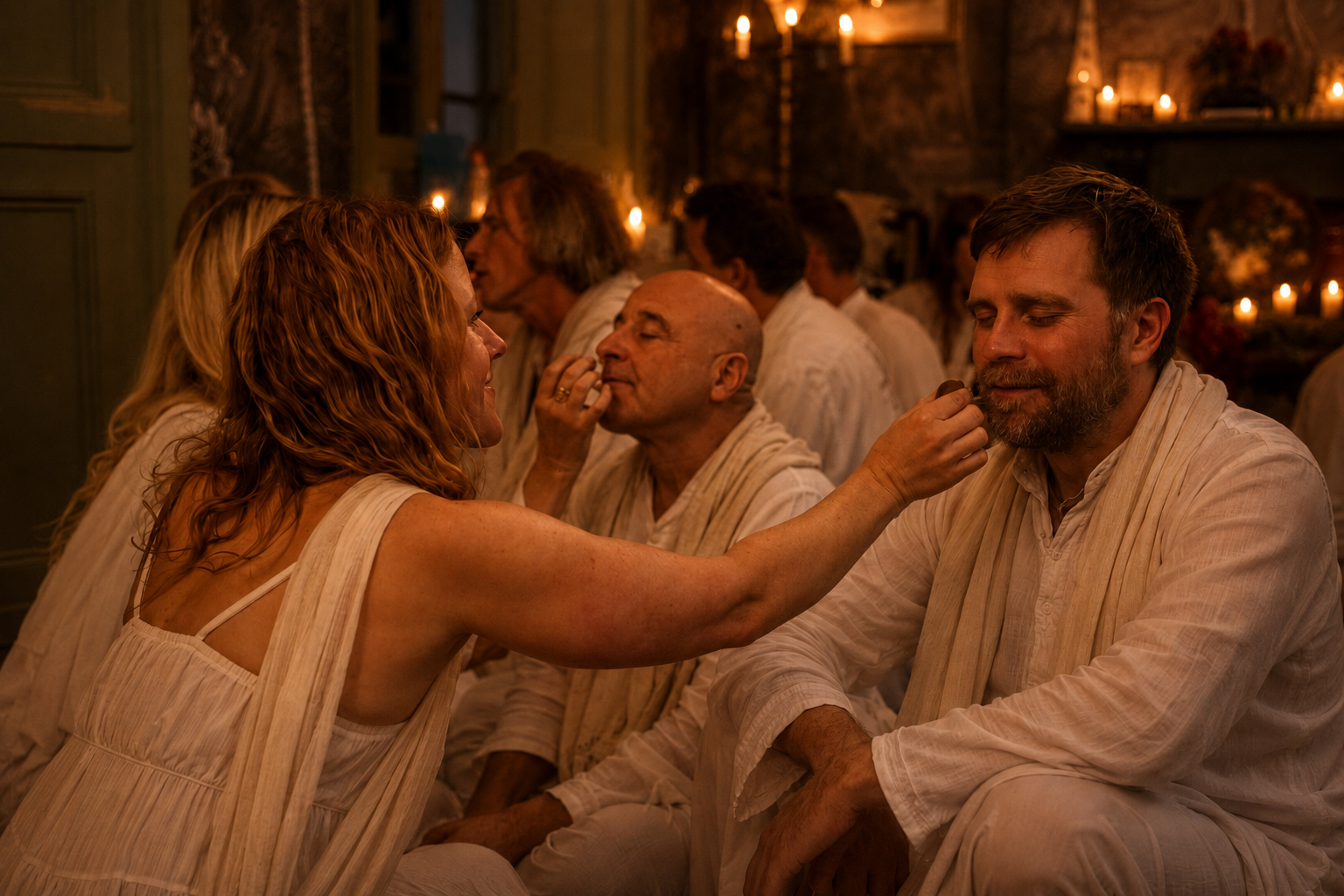
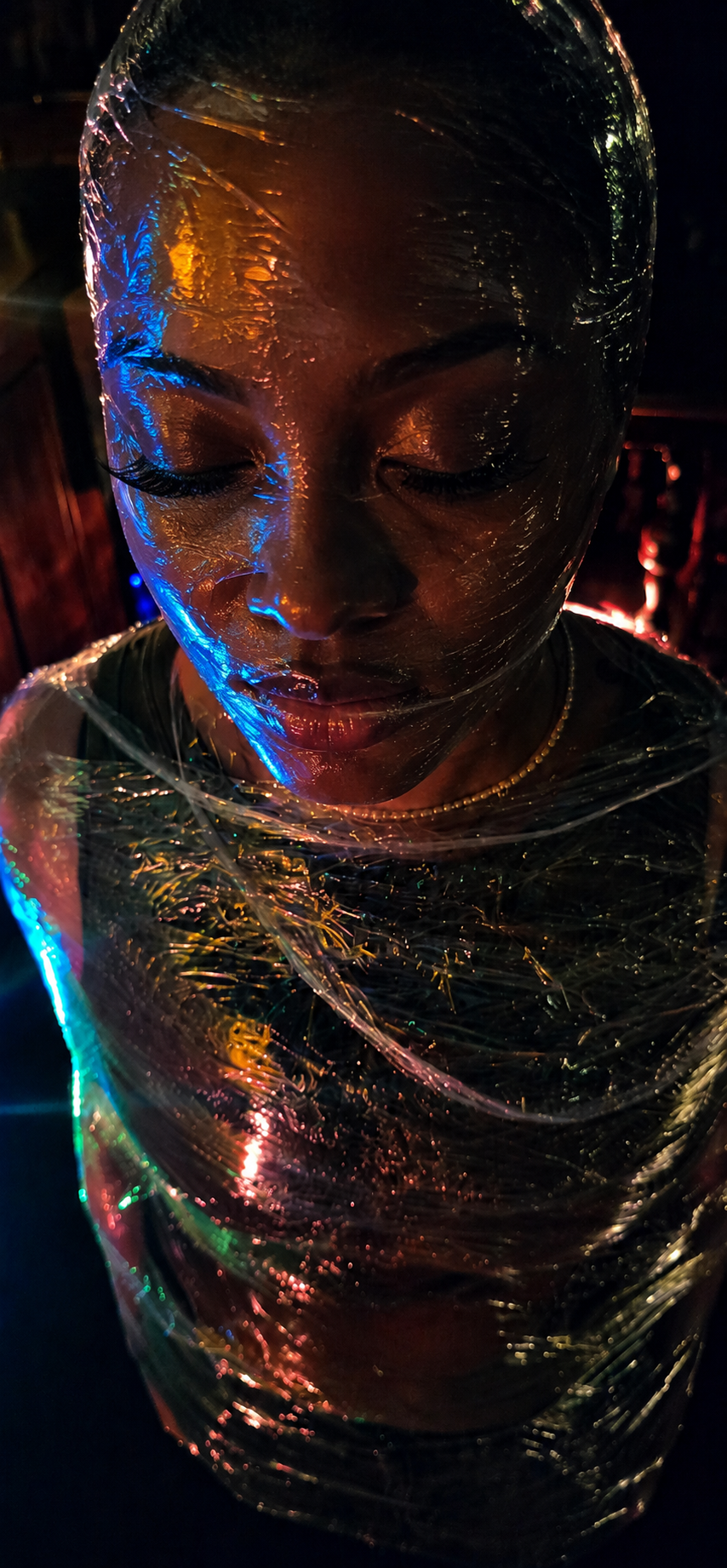
We close with the tenderest part, and for some people the most unfamiliar: conscious touch, group massage, and swaddling - being gently wrapped and held, partly or completely (yes, mummified, if you fancy :)). There's a strange, deep peace in being fully held - in handing yourself over to other people's care and being let off the exhausting job of holding yourself up for once. To be safely bound and cradled by the group is to be handed back something close to the ease of being very small and very safe. It's healing through connection, plainly, and it's where the whole day has been heading.
What it isn't
Because this is easy turf to misread:
It's not a sex party. It's sensual, not sexual, and we really do mean the distinction. There's bare skin and there's closeness, but the whole feel of it is reverent rather than charged.
It's not a tantra temple, and we're not a spiritual school. Nobody's going to hand you a doctrine or sell you an awakening.
And it's not a standard-issue "conscious" event either. No cacao ceremony doing the heavy lifting, no facilitator voice, none of the obligatory solemnity. What it has instead is the thing we can't help bringing to anything we make: theatre. The same love of staging, beauty and ceremony that runs through all our after-dark worlds, just carried out in daylight, in near-silence, in white.
Dress code
We're asking everyone to wear head-to-toe white not as a costume but so that we shed our usual colours and signals and walk into this together, as one bright congregation, hard to tell apart. It's the whole idea made visible.
We still get the odd flicker of who-are-we-to-do-this. But we keep landing on the same answer: because these are the things we love most, the ones that have moved us deepest, and we can't wait to finally give them a room of their own.
We'd love you to come find it with us.