Inside the world of Fox&Badge (LCK Magazine)
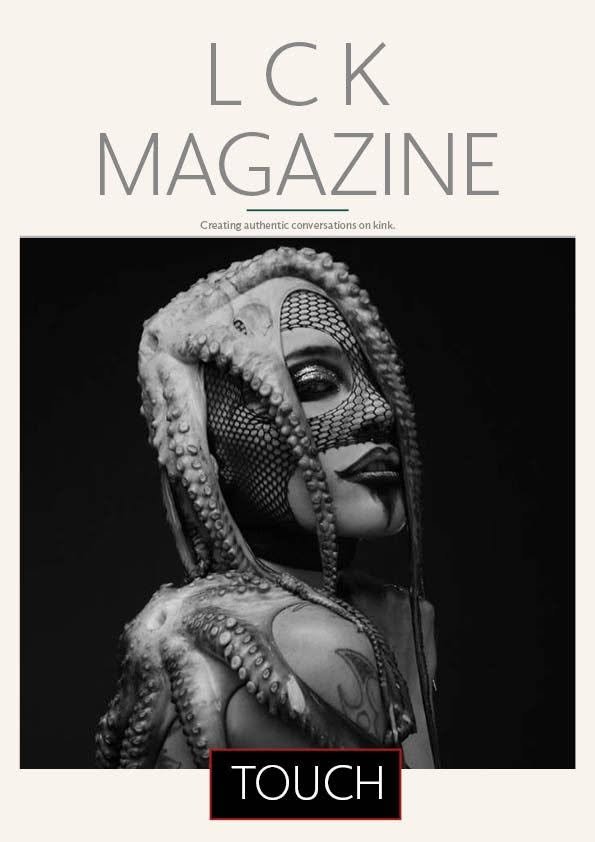
A write-up of Fox&Badge following our September 2025 Wild West event by Raven Oxide, editor of LCK magazine.
LCK (Life / Conversations / Kink) is an effort to reconnect with the analogue - and to both educate and delight. It’s a print-only publication full of stories, photographs, and resources for all things kink (and as beautiful as a coffee table book!). This issue focused on TOUCH and Fox&Badge have a 2-page spread on the meaning behind the events, what inspires us, how they’ve evolved, and what we’re dreaming of.
You can get a copy of your own for £11.99 at: lckmag.com/product/touch-issue-2/
Immersion, Permission, Transformation: Inside the World of Fox & Badge
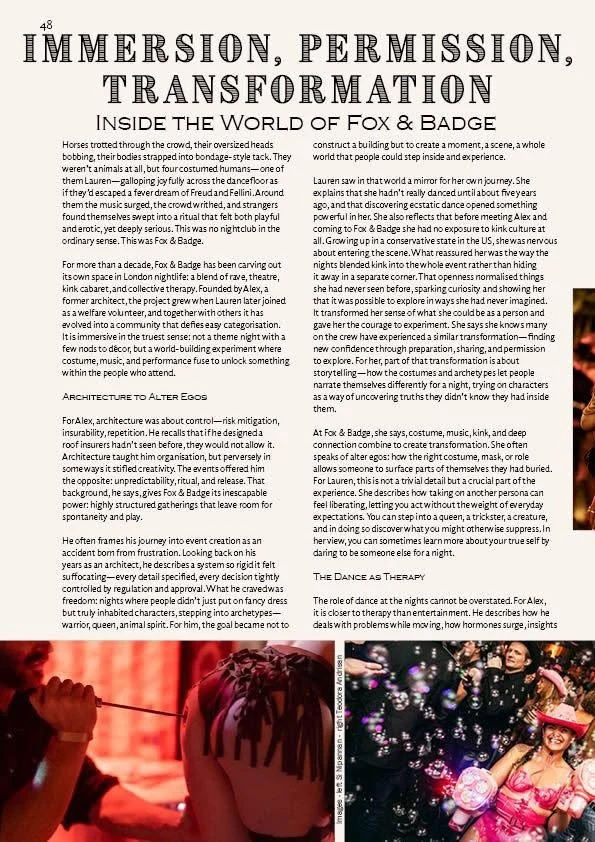
Horses trotted through the crowd, their oversized heads bobbing, their bodies strapped into bondage-style tack. They weren’t animals at all, but four costumed humans—one of them Lauren—galloping joyfully across the dancefloor as if they’d escaped a fever dream of Freud and Fellini. Around them the music surged, the crowd writhed, and strangers found themselves swept into a ritual that felt both playful and erotic, yet deeply serious. This was no nightclub in the ordinary sense. This was Fox&Badge.
For more than a decade, Fox & Badge has been carving out its own space in London nightlife: ablend of rave, theatre, kink cabaret, and collective therapy. Founded by Alex, an architect, the project grew when Lauren later joined as a welfare volunteer, and together with others it has evolved into a community that defies easy categorisation. It is immersive in the truest sense: not a theme night with a few nods to décor, but a world-building experiment where costume, music, and performance fuse to unlock something within the people who attend.
Architecture to Alter Egos
For Alex, architecture was about control—risk mitigation, insurability, repetition. He recalls that if he designed a roof insurers hadn’t seen before, they would not allow it. Architecture taught him organisation, but perversely in some ways it stifled creativity. The events offered him the opposite: unpredictability, ritual, and release. That background, he says, gives Fox & Badge its inescapable power: highly structured gatherings that leave room for spontaneity and play.
He often frames his journey into event creation as an accident born from frustration. Looking back on his years as an architect, he describes a system so rigid it felt suffocating—every detail specified, every decision tightly controlled by regulation and approval. What he craved was freedom: nights where people didn’t just put on fancy dress but truly inhabited characters, stepping into archetypes—warrior, queen, animal spirit. For him, the goal became not to construct a building but to create a moment, a scene, a whole world that people could step inside and experience.
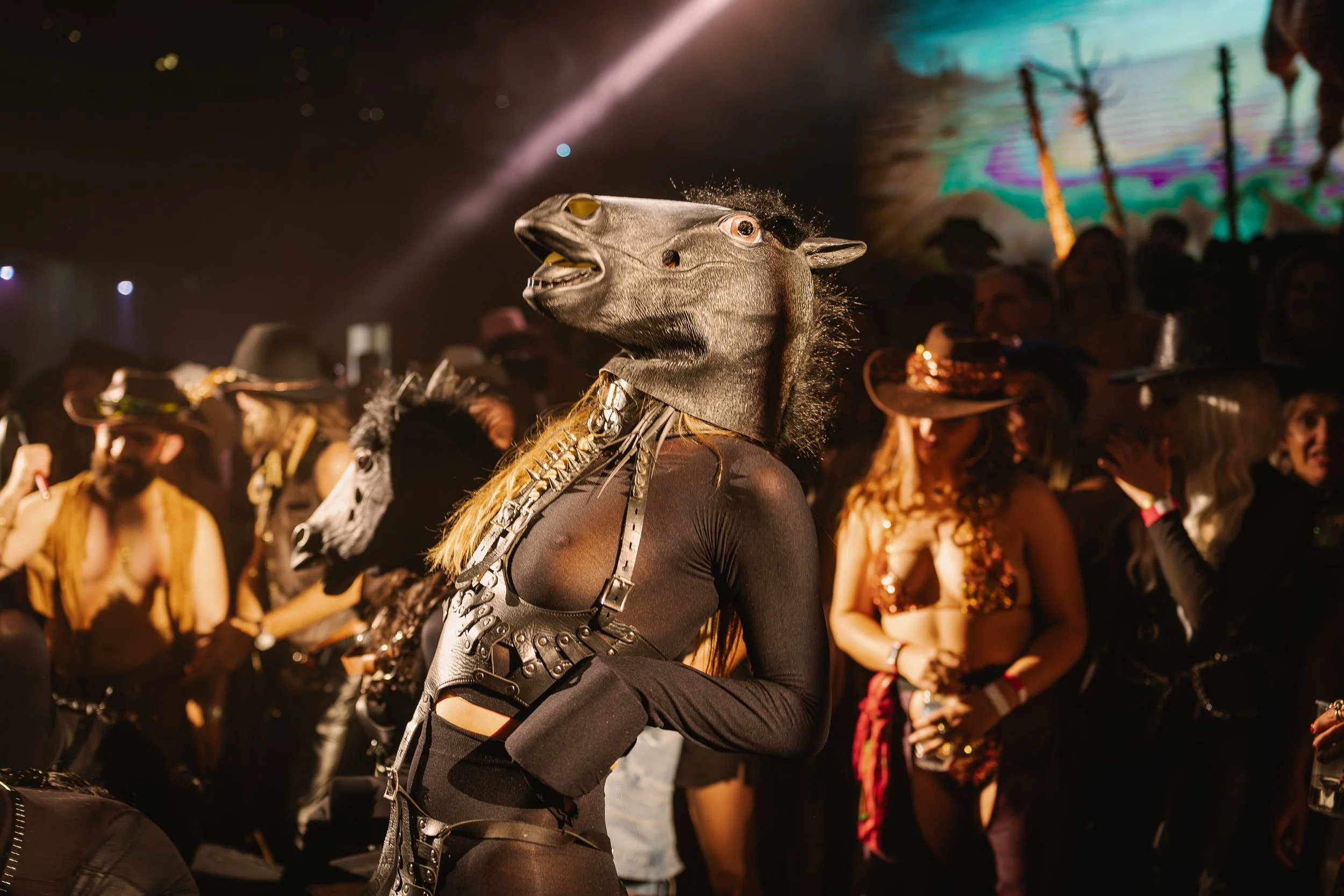
Lauren saw in that world a mirror for her own journey. She explains that she hadn’t really danced until about five years ago, and that discovering ecstatic dance opened something powerful in her. She also reflects that before meeting Alex and coming to Fox & Badge she had no exposure to kink culture at all. Growing up in a conservative state in the US, she was nervous about entering the scene. What reassured her was the way the nights blended kink into the whole event rather than hiding it away in a separate corner. That openness normalised things she had never seen before, sparking curiosity and showing her that it was possible to explore in ways she had never imagined. It transformed her sense of what she could be as a person and gave her the courage to experiment. She says she knows many on the crew have experienced a similar transformation—finding new confidence through preparation, sharing, and permission to explore. For her, part of that transformation is about storytelling—how the costumes and archetypes let people narrate themselves differently for a night, trying on characters as a way of uncovering truths they didn’t know they had inside them.
At Fox & Badge, she says, costume, music, kink, and deep connection combine to create transformation. She often speaks of alter egos: how the right costume, mask, or role allows someone to surface parts of themselves they had buried. For Lauren, this is not a trivial detail but a crucial part of the experience. She describes how taking on another persona can feel liberating, letting you act without the weight of everyday expectations. You can step into a queen, a trickster, a creature, and in doing so discover what you might otherwise suppress. In her view, you can sometimes learn more about your true self by daring to be someone else for a night.
The Dance as Therapy
The role of dance at the nights cannot be overstated. For Alex, it is closer to therapy than entertainment. He describes how he deals with problems while moving, how hormones surge, insights come, and how difficult it is to feel sad when immersed in rhythm. Science backs this up: dance is known to release endorphins and oxytocin, reduce cortisol levels, and activate brain regions linked to reward and emotional regulation. In other words, the euphoria and clarity people feel on the dancefloor have measurable physiological roots as well as emotional ones.
They develop this further, portraying dance as collective eros. Intimacy in another form—an energy that flows between bodies. On the floor you are vulnerable, exposed, and raw, yet you discover connection, joy, and sometimes even healing. It becomes a ritual where sweat, rhythm, and eye contact replace words, and the intimacy is every bit as real as sex itself. At times it feels like prayer, at others like rebellion—a sacred yet messy form of worship where you can cry, laugh, grind, and collapse all in the same set. It is not performance for others but revelation for yourself, and that is why it feels so vital. The pair also stress how different this is from most club or play spaces, where dance is treated as backdrop or entertainment. At Fox&Badge, dance is the main medium of connection and exploration, making the whole experience less about spectacle consumed and more about vulnerability shared.
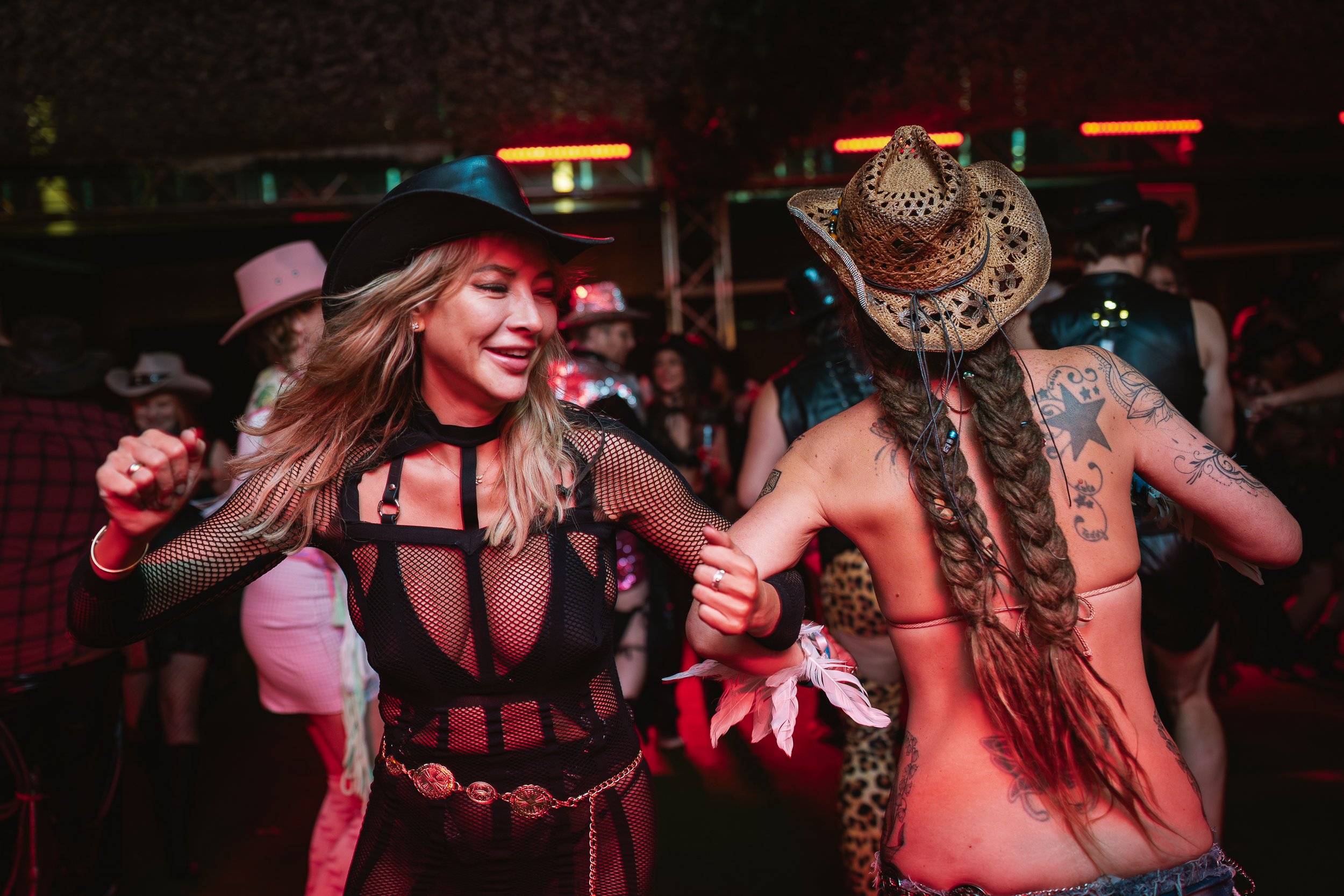
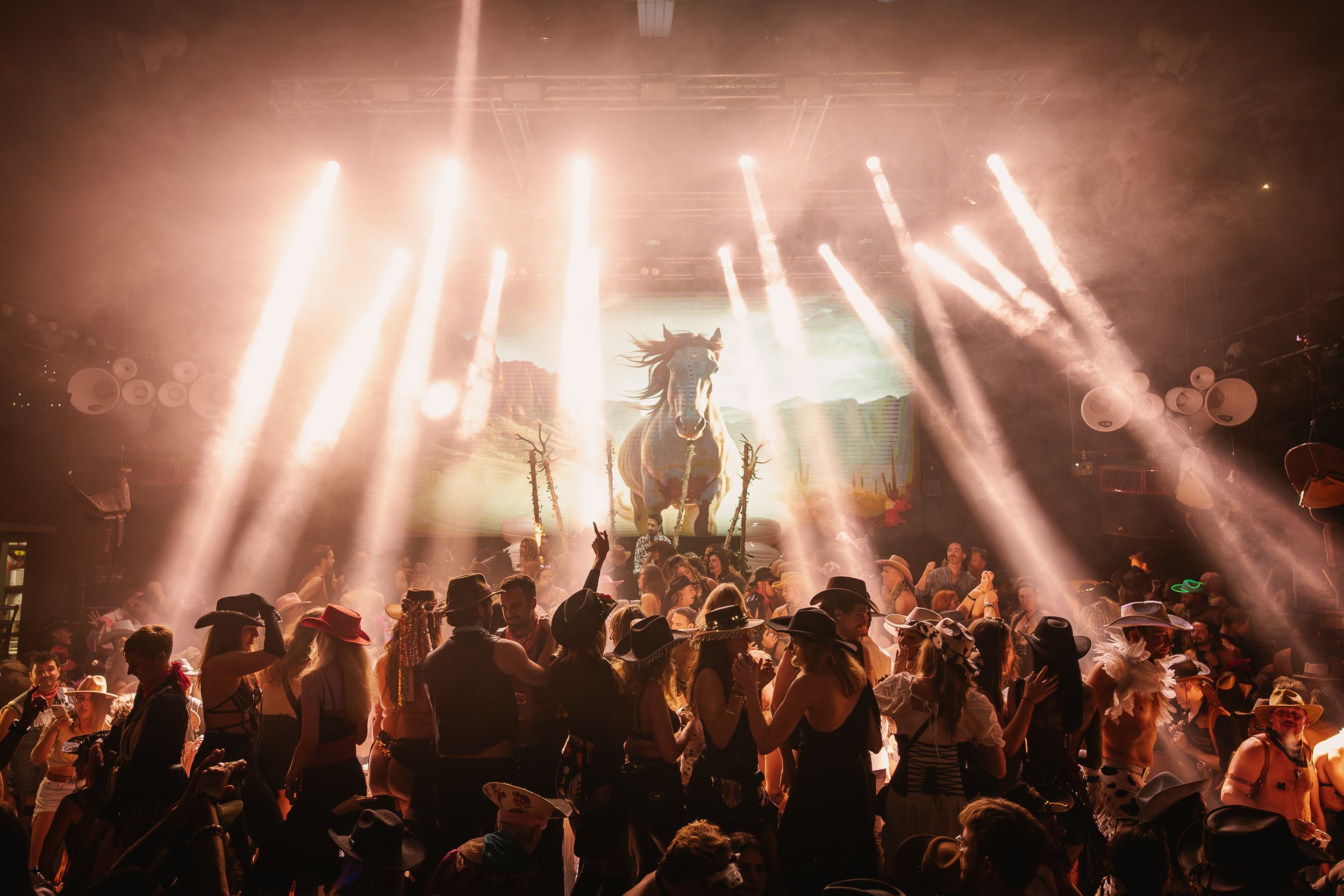
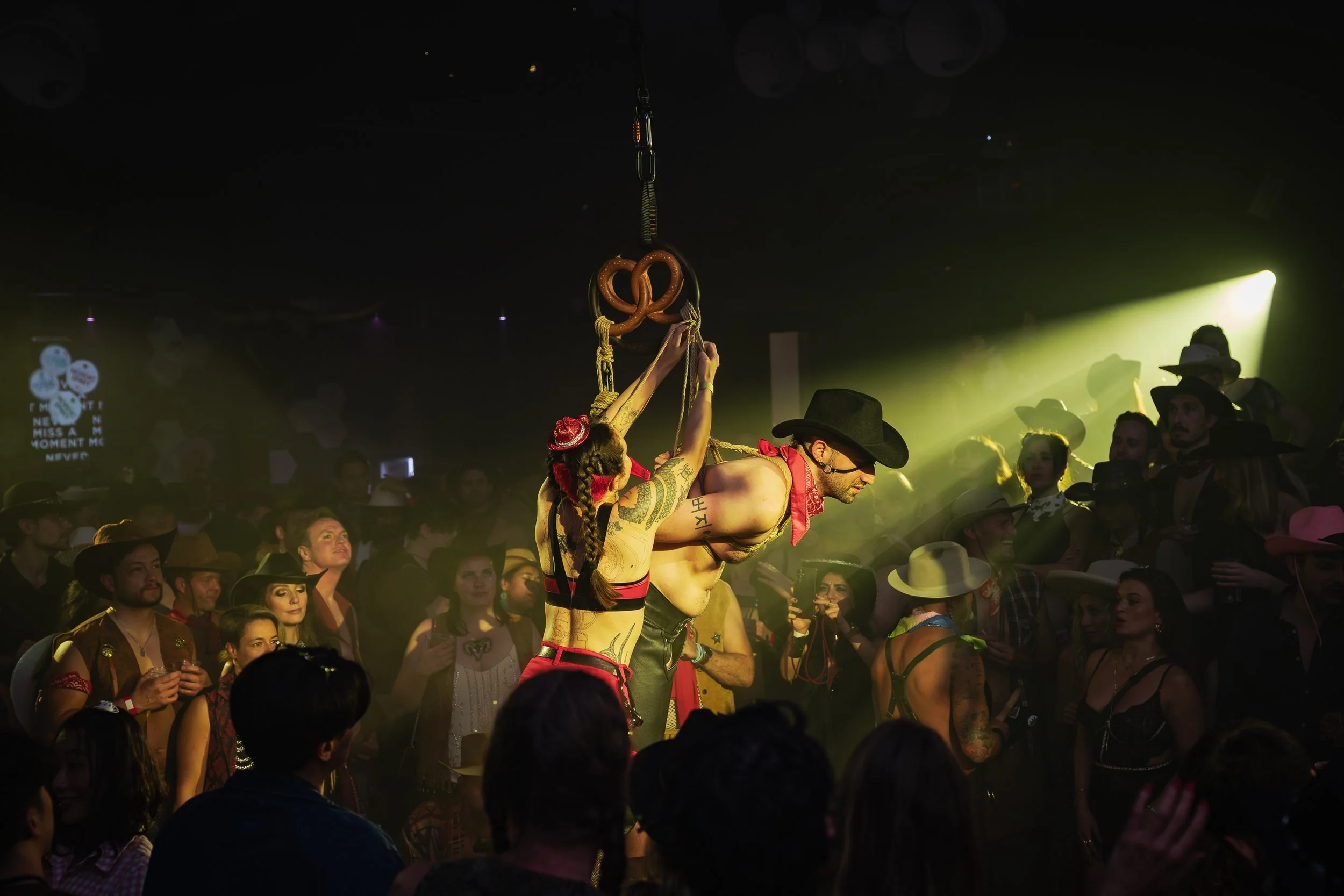
That connection is deliberately cultivated. Performances happen in the round, stages are set within in the crowd, lines become blurred until guests and performers are almost indistinguishable. Alex insists that the guests themselves are part of the show, describing how they strip out the balustrades, remove VIP barriers, and bring everyone onto the stage. There is no hierarchy—just participation.
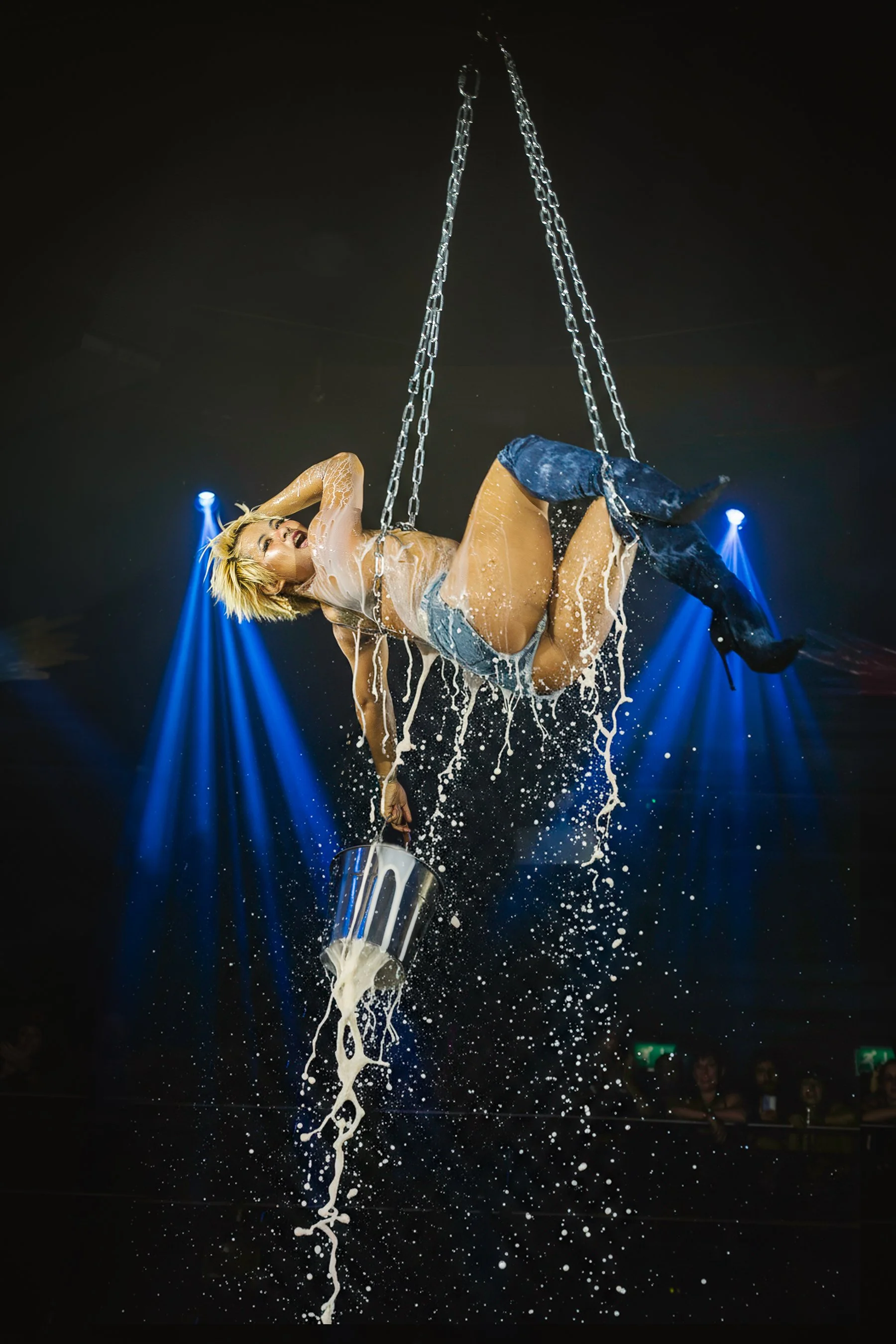
Touch and sensation weave through these moments: the heat of bodies pressed together, the cool shock of water in ritual, the brush of feathers or the tug of rope in a performance. Each space within a venue is treated like a character in itself—rooms given names, atmospheres, and roles to play. A boudoir upstairs might be soft and warm, while another area channels something raw and agricultural. Stations and corners are set to invite archetypes out of hiding, helping guests lean into the roles they have chosen.
This approach, influenced by therapeutic models like Internal Family Systems (IFS), developed by Dr. Richard Schwartz in the 1980s. IFS suggests that we all carry multiple 'parts' within us—an inner critic, a wounded child, a hidden protector, or a fiery animal spirit—and that healing comes from recognising, integrating, and giving space to each of them. The events encourage people to access those parts—whether achild, a warrior, or an animal spirit—and find healing through permission to play. Guests leave not only with memories but with the felt imprint of textures, sounds, and embraces. Fox & Badge thrives on these sensory collisions, reminding people that pleasure lives in the whole body.
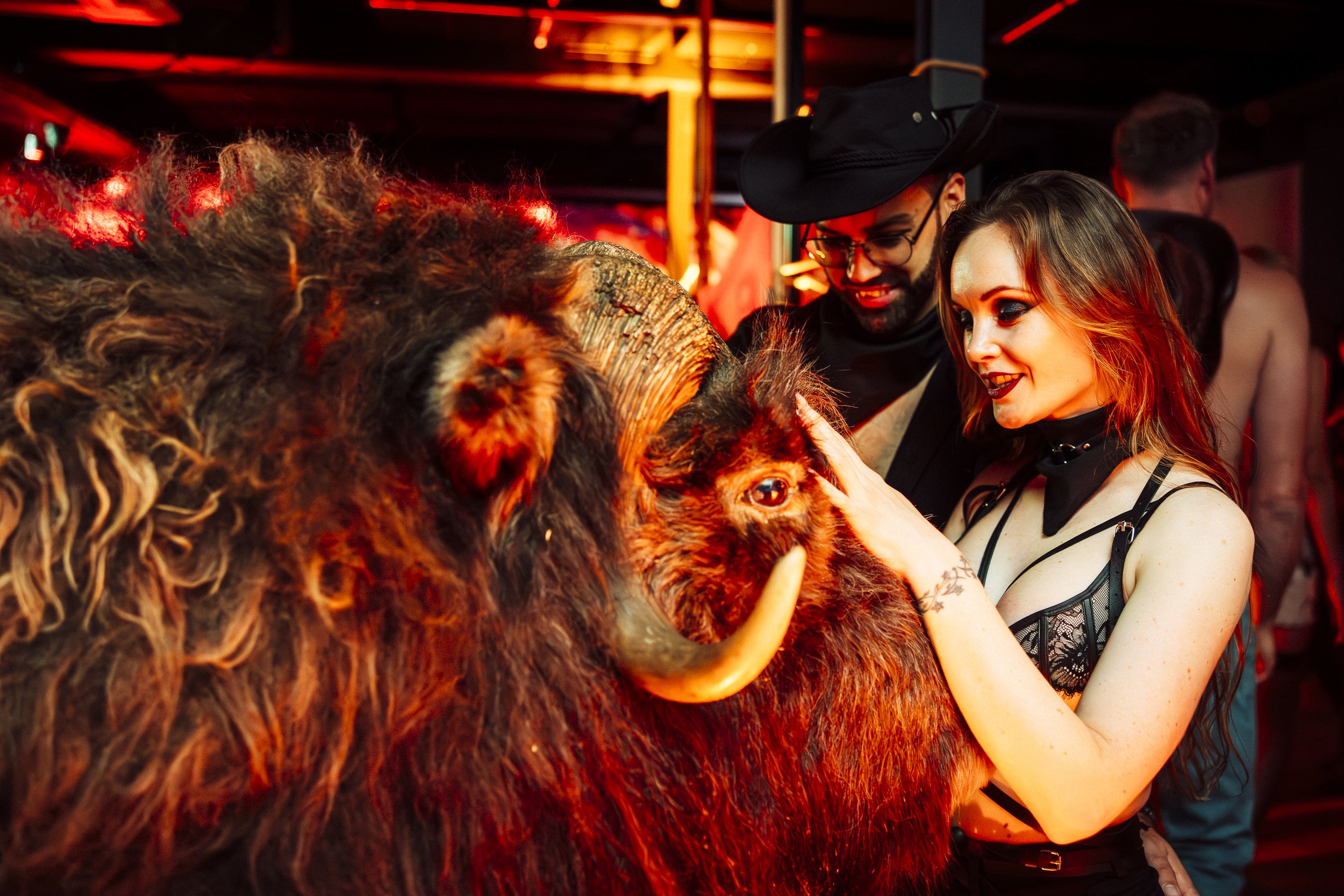
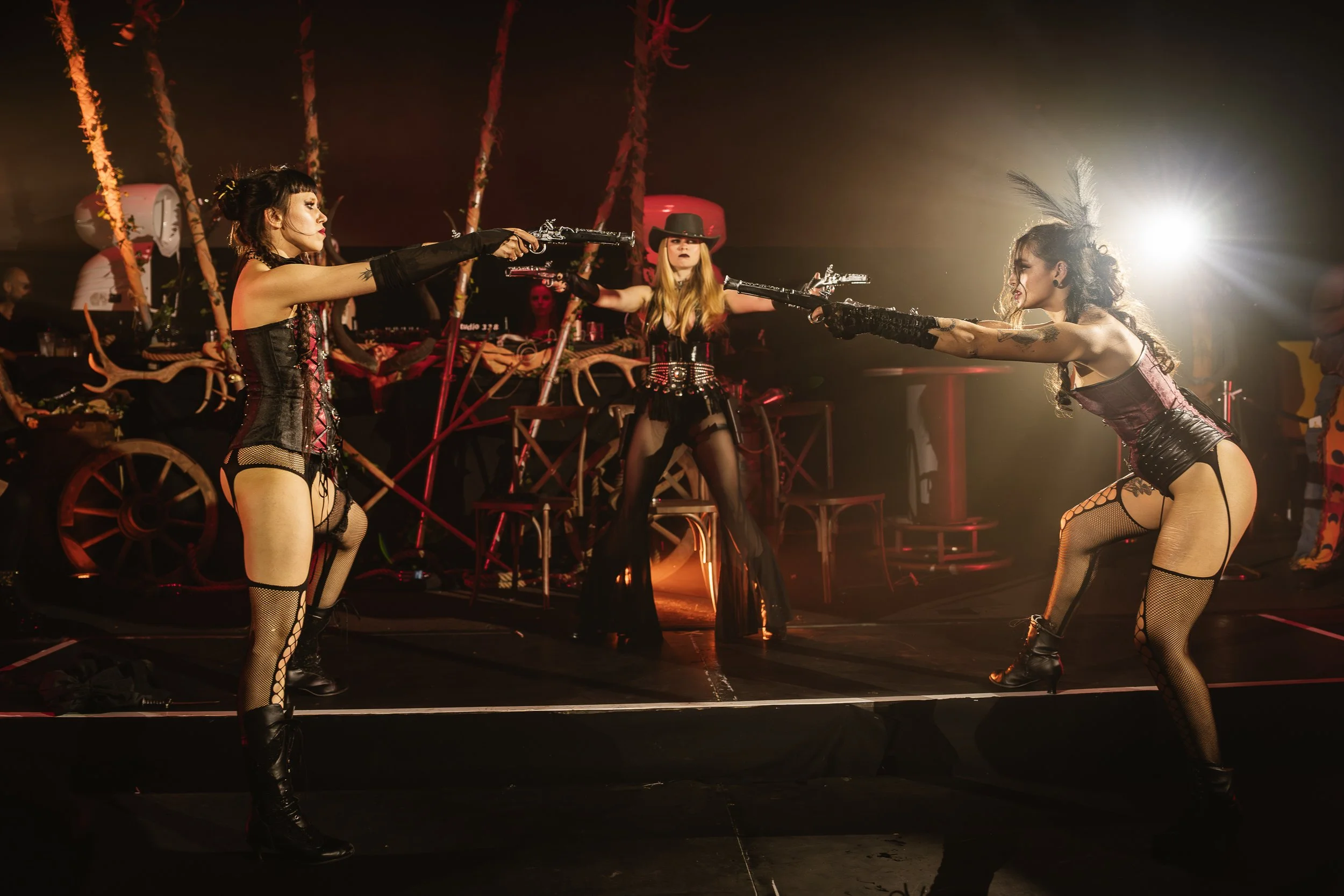
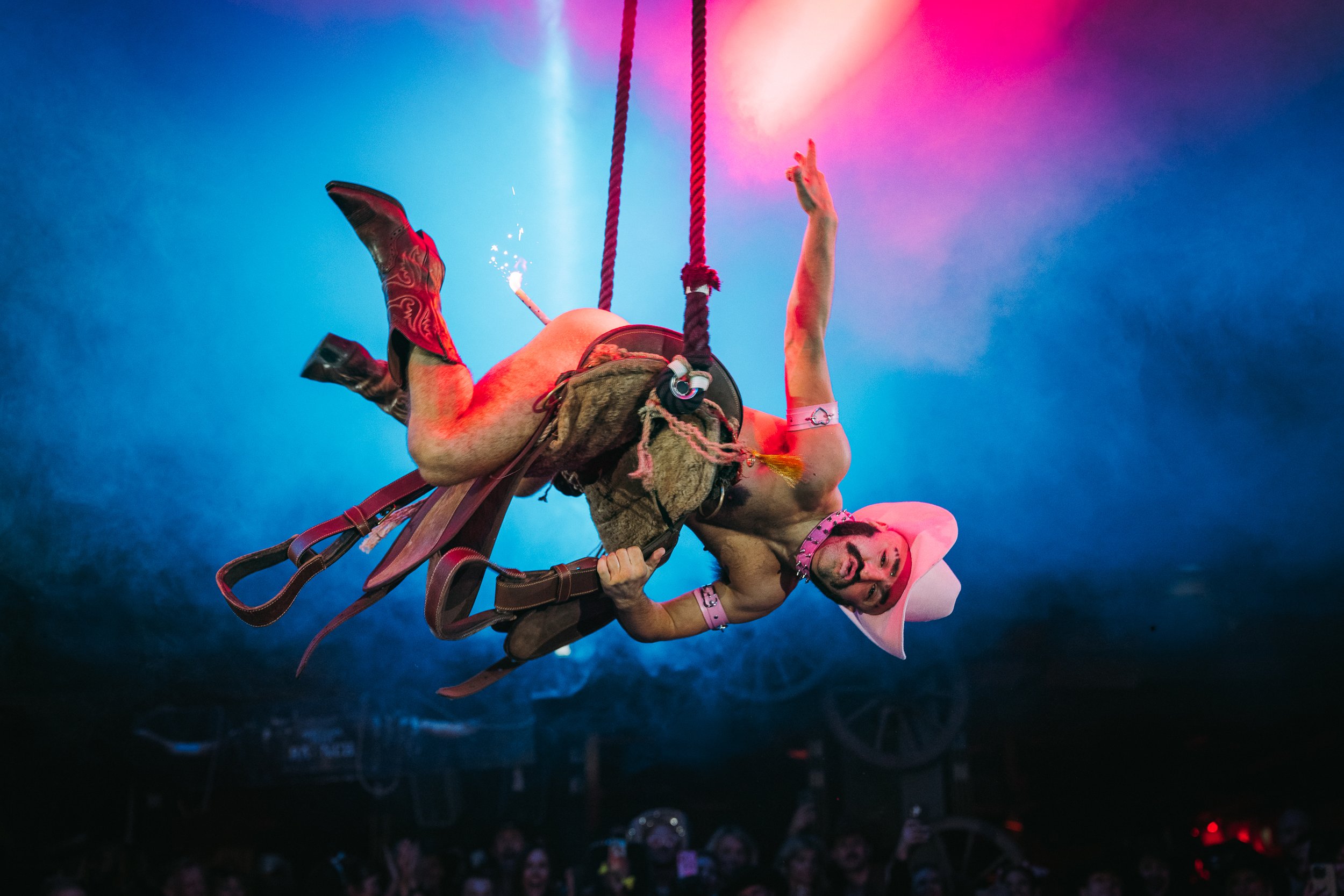
The décor and staging reinforce this ethos, often designed as interactive rather than untouchable— swings hung from ropes, rideable props, or playful installations that invite guests to climb and laugh. It is closer to an adult playground than a museum, a space where freedom and vulnerability meet. It is also, at its core, about permission. Alex’s gift is recognising what someone really wants beneath what they say, and quietly granting them the go-ahead to explore it. That sensitivity, scaled up, becomes the ethos of the events: giving a whole room permission to reconnect with their inner child, to drop the armour of adulthood, and to play without apology.
Care, Community, Continuity
But transformation doesn’t only happen on the dancefloor. Fox & Badge nights are carefully scaffolded with welfare and care.The welfare team offers massages, tea, grounding touch, and long conversations throughout the night. What began as a safe corner for those overwhelmed or in distress has grown into a hub of connection—where strangers sit cross-legged on cushions, share stories, and rebuild themselves before returning to the dancefloor or other busy communal spaces. Alex explains that while the space was first intended for those having a bad time, it quickly became a place for anyone seeking connection, kindness, or simply a reminder that they are not alone.
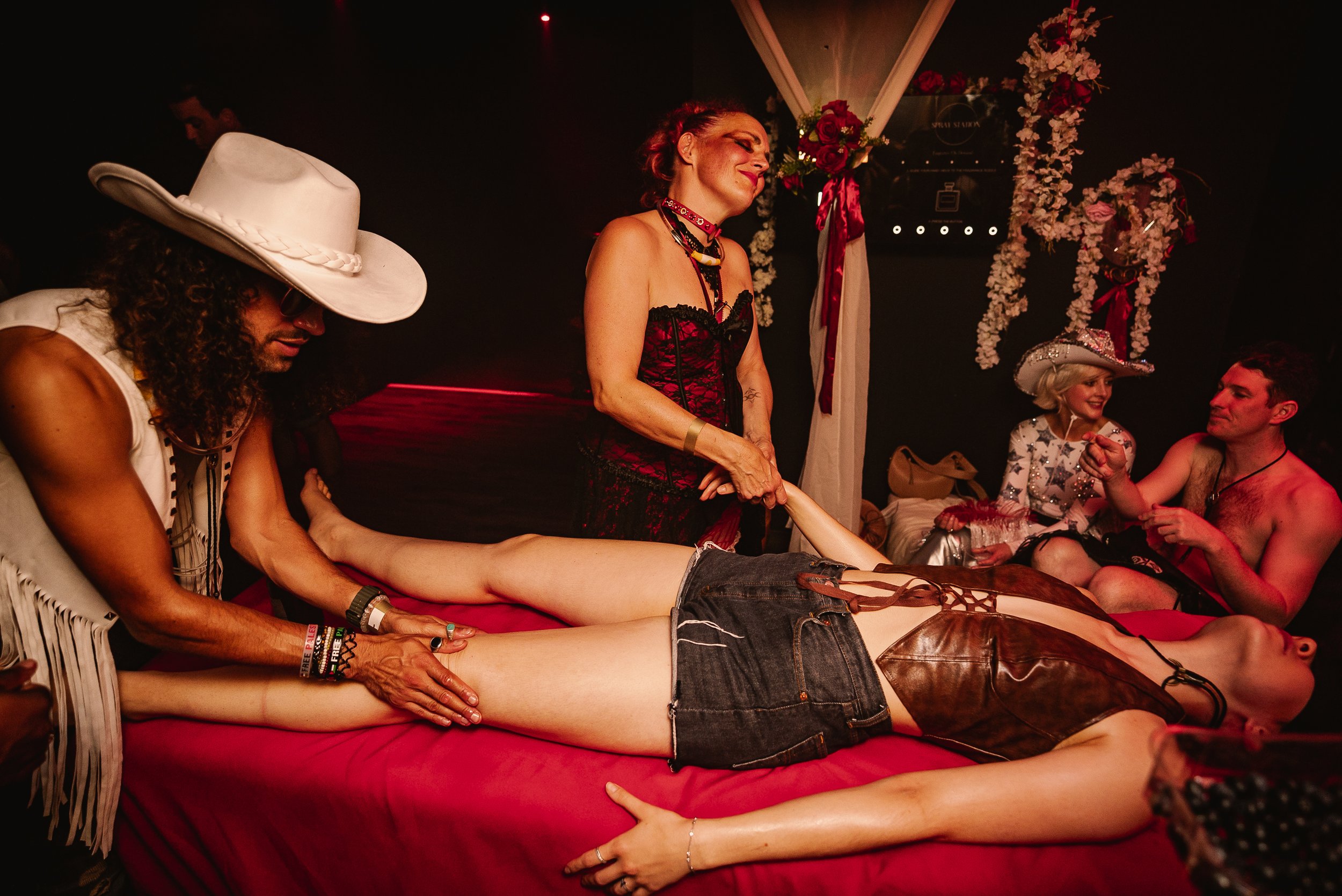
In fact the whole event holds this vibe. As Lauren puts it, it is good to be able to hold a safe space for people who don’t align with other parts of the community—people who need to feel they can dress how they want and feel how they want. Not only are they not going to be judged, but they will also find others the same as them. That gives them the space not just to feel safe but to feel normal, to normalise who they are. It feeds their strength to go back out into the world thinking: “I’m okay. Not only have they had a wonderful experience for the evening, but they carry that strength back into their everyday lives, which in turn feeds into the wider community.”
Beyond the flagship events, practical support also helps people feel included long before they arrive. Online guidance sits alongside in-person workshops so no one feels alienated or lost before an event. These preparations reassure guests that they will belong once they step inside.
Smaller socials keep the community alive: techno singing circles, mummification workshops, and other playful gatherings designed to disarm formality and open people up. There are also meet-ups in cafés, casual walks, and experimental sessions where participants try out storytelling, guided rituals, or simply sit in circles sharing food. These in-between moments matter: they give newcomers a gentler entry point and long-time members a chance to deepen friendships. Lauren describes them as carrying both innocence and edge, a space where you are given permission to play, to rediscover archetypes, to embody exiled parts of yourself. She sees it as healing—not just about one big night but about weaving a thread of connection that runs through people’s everyday lives.
She explains further that these events also work as practice grounds for life itself. When you make a mask or step into a character for a night, you give yourself permission to try being louder, softer, stranger, freer. That practice doesn’t just vanish when the music stops—it carries into work, relationships, and how you hold yourself in the world.
Themes, Spectacle and Permission
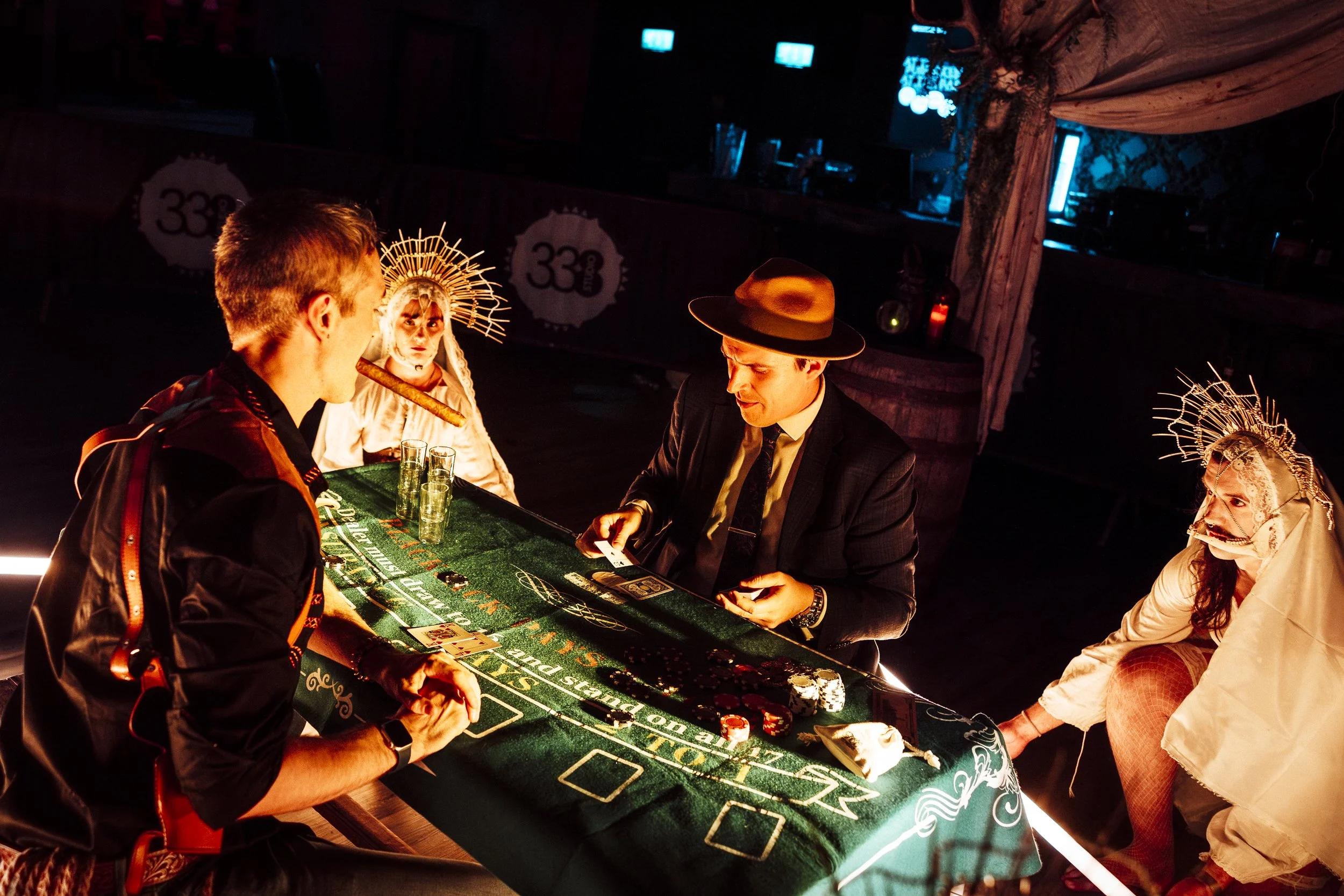
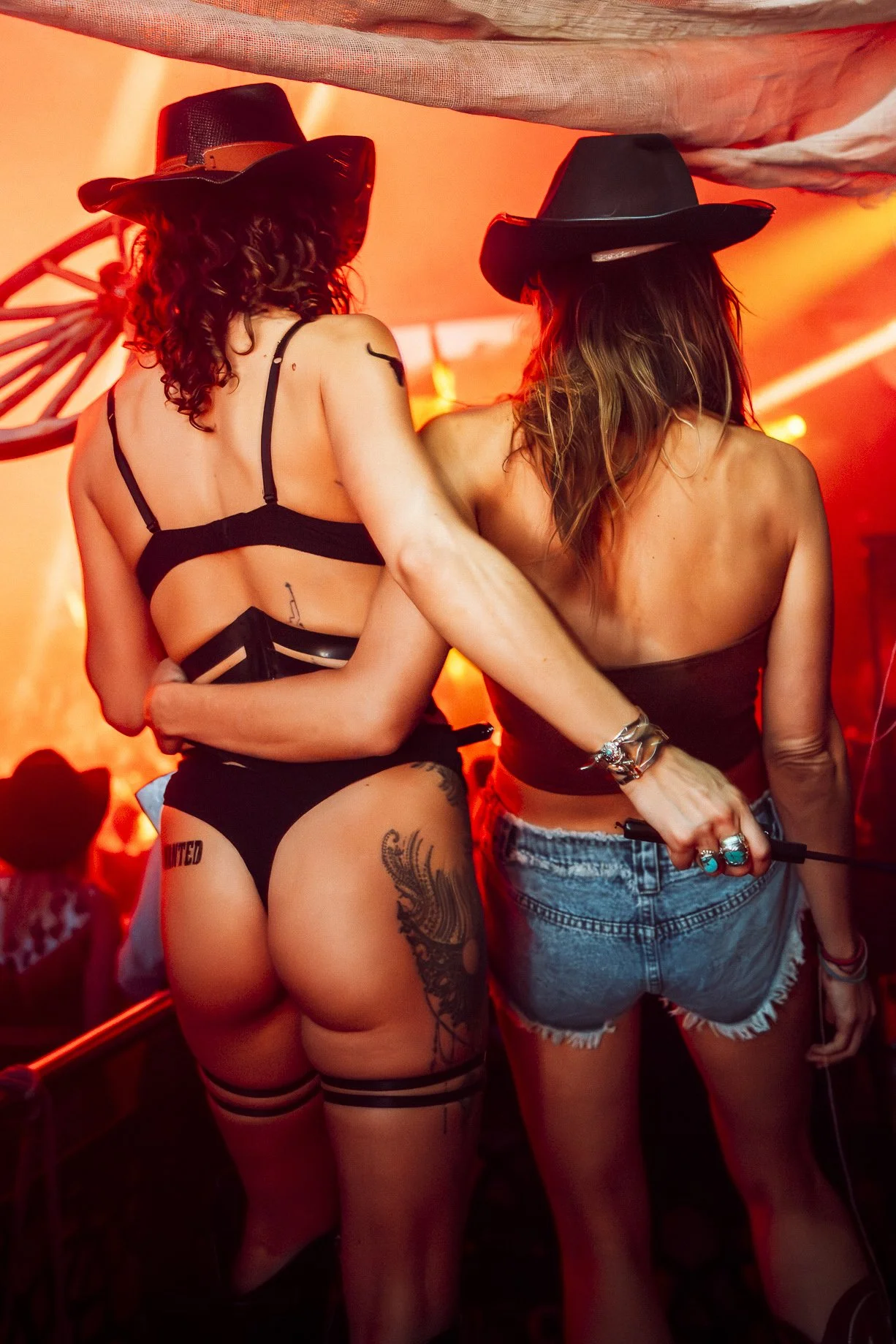
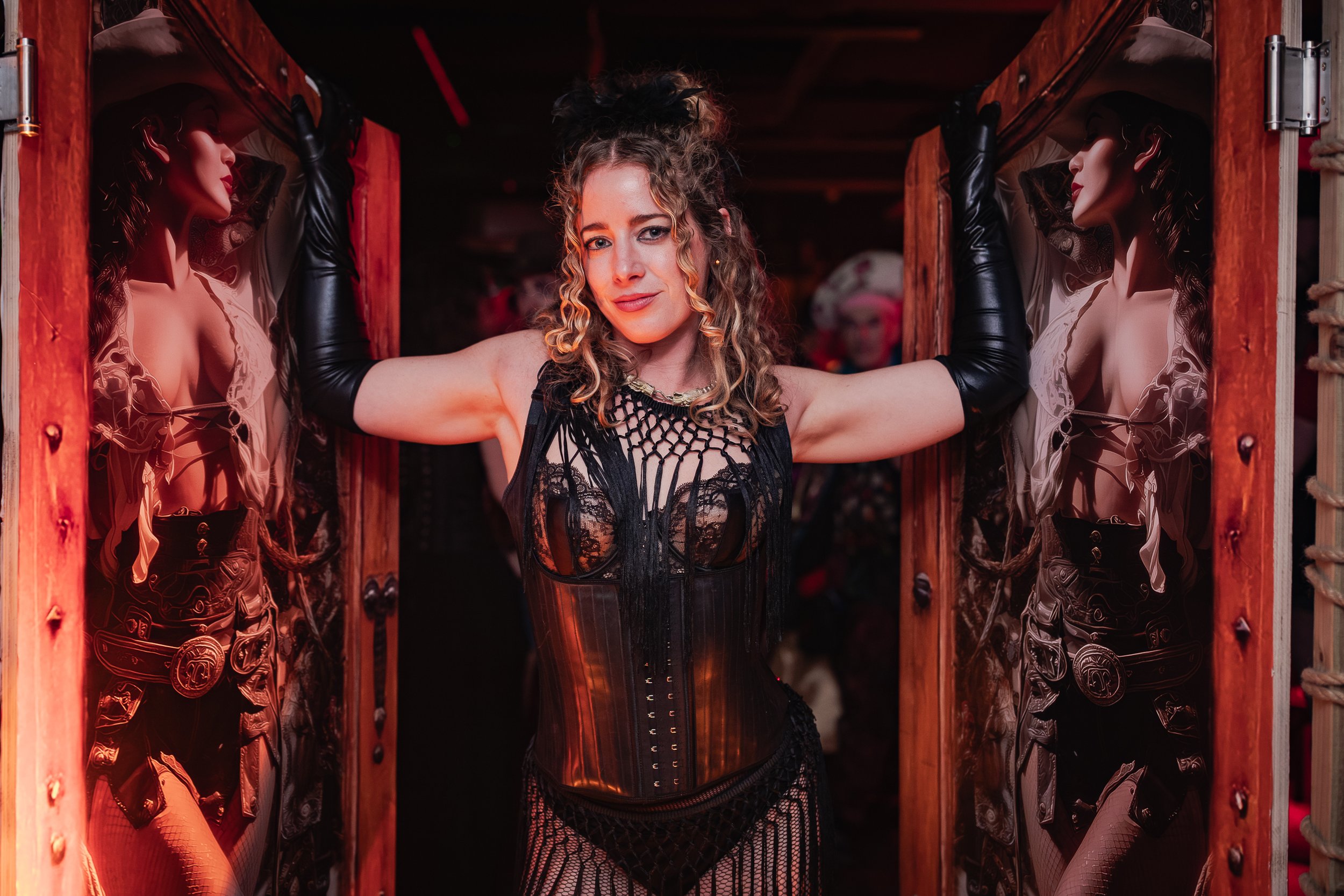
One of the most carefully considered aspects of Fox & Badge is its use of themes. For Alex, the strongest nights are those with coherence and unity—where everyone feels part of one tribe, whether Vikings, Mad Max survivors, or a carnival of birds. Outliers are always welcomed, but coherence helps dissolve anxiety and builds confidence. Particular care is taken to ensure themes are inclusive across genders. The team are especially mindful that men can sometimes find costuming harder, so if a concept makes it difficult for them to feel comfortable dressing up, or there are less options, it is set aside. A Wild West night worked beautifully because it gave both clarity and scope, helping people feel part of a shared world rather than isolated in their own costumes.
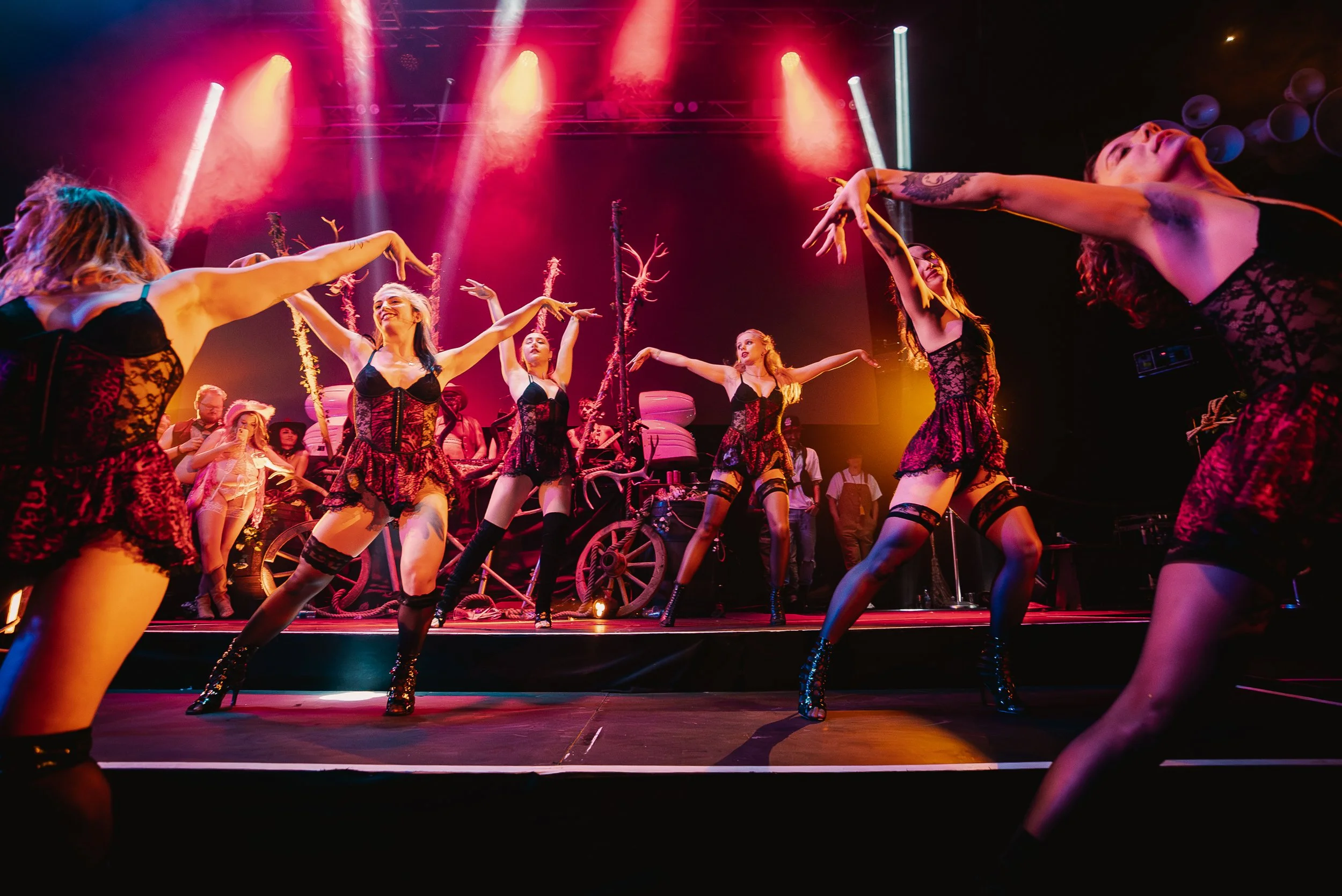
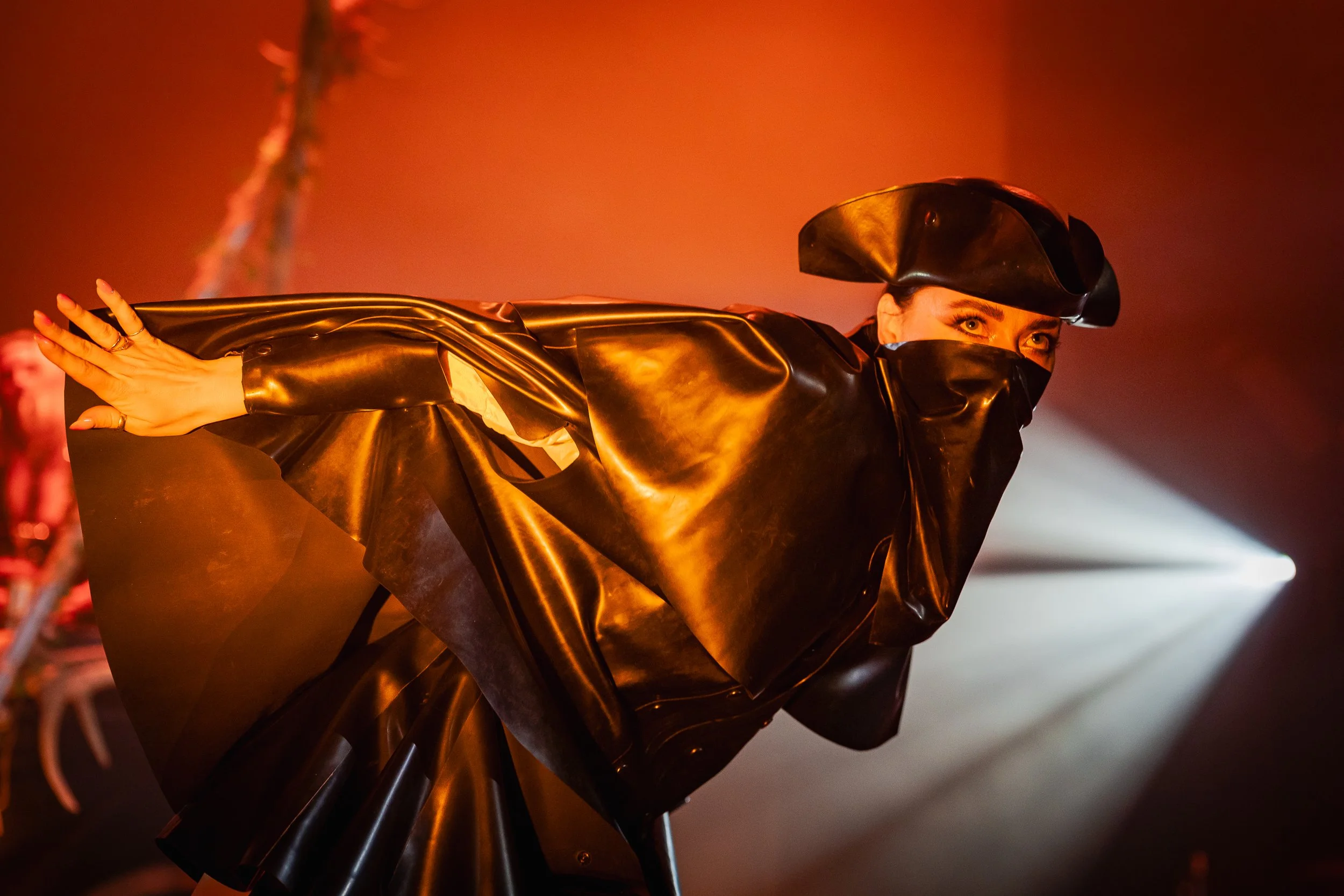
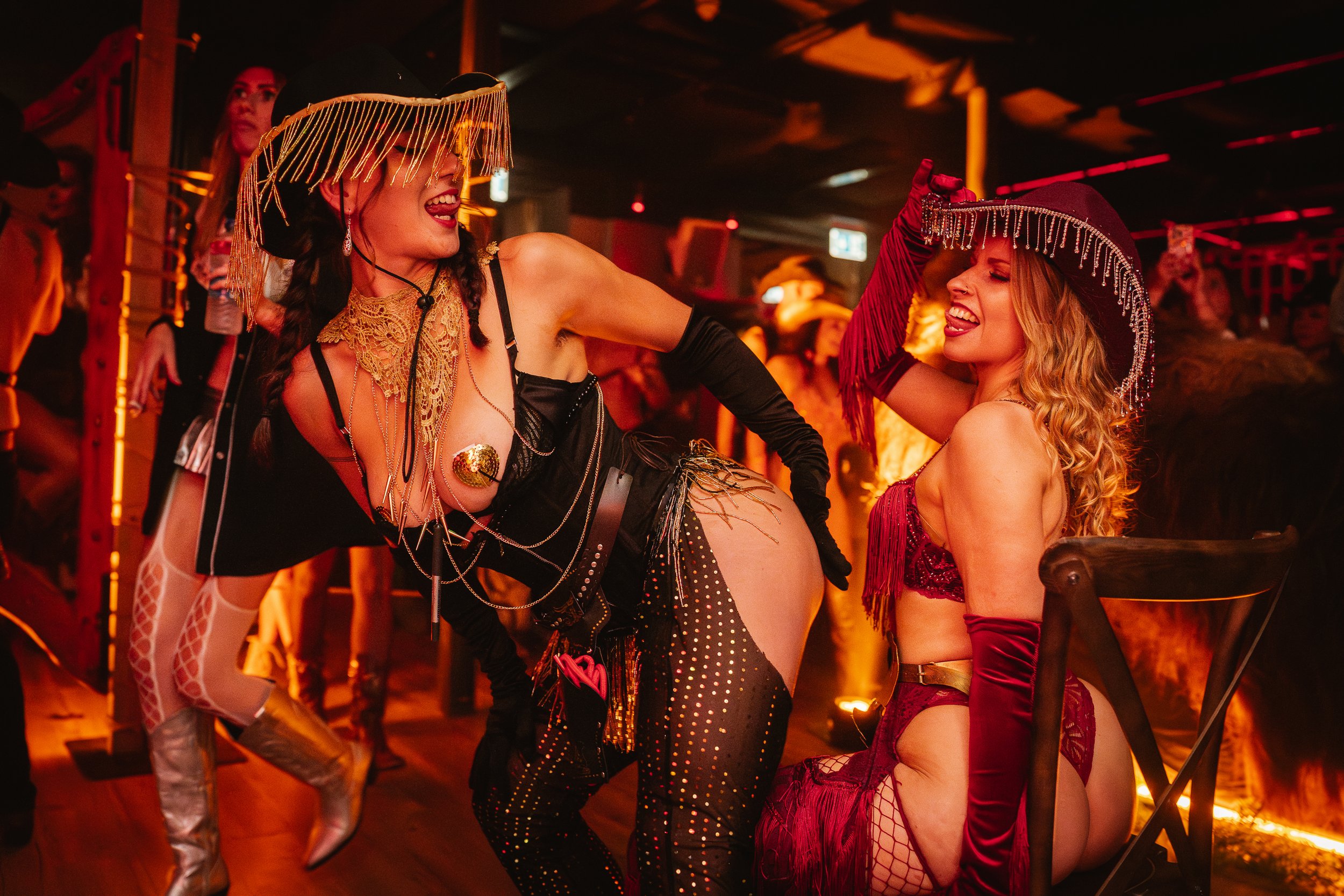
The intention is not to dictate but to immerse. The best themes, Alex and Lauren argue, help guests embody something beyond themselves, transporting them into a film-set-like environment where lighting, costume, and music all conspire to create atmosphere. Even within those frameworks, playful contradictions are welcomed: a modern cowboy on roller skates, neon palettes clashing with sepia tones. These deliberate touches remind guests that the events are not historical re-enactment but a living, breathing act of collective imagination.
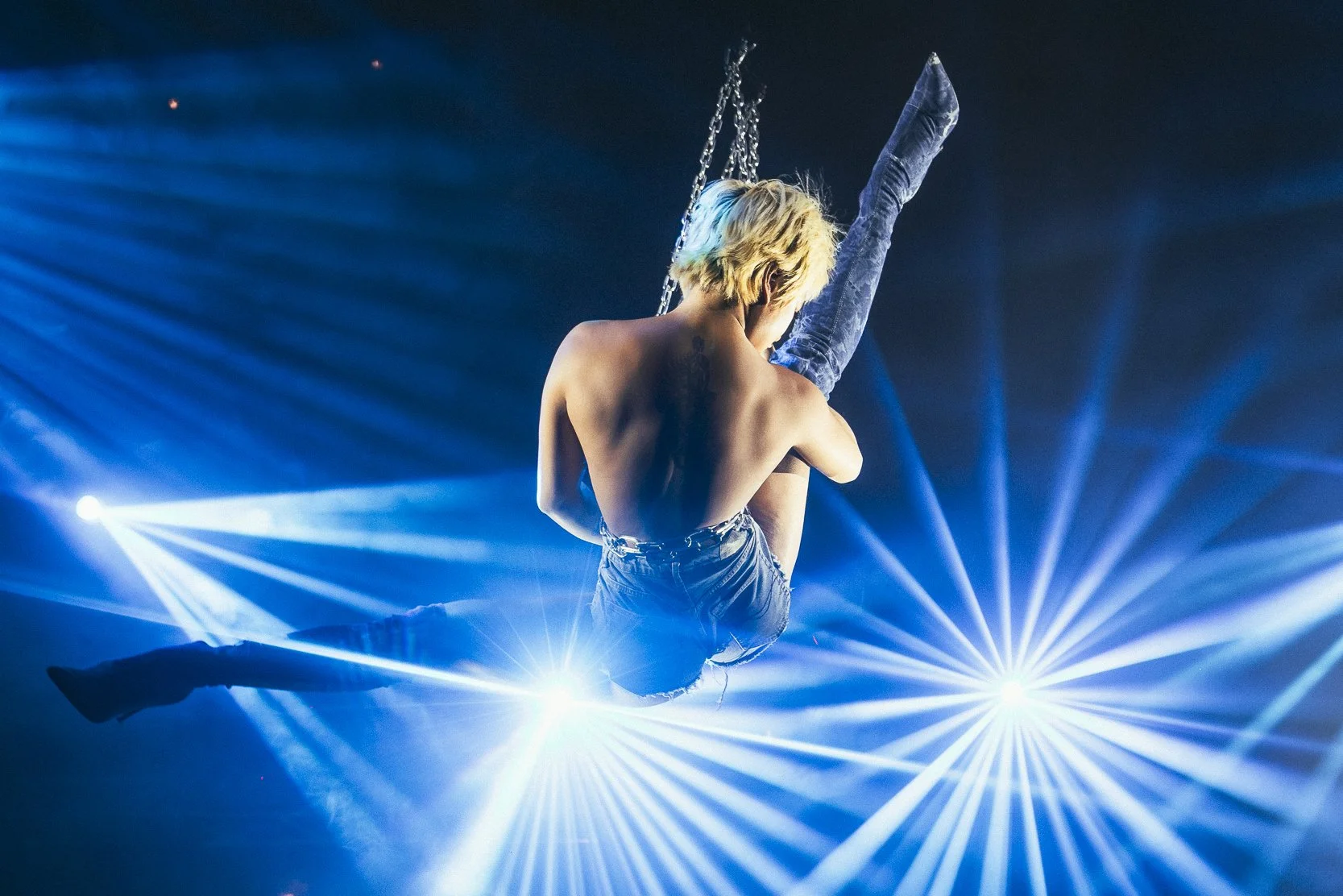
The events may draw on spectacle—rituals with sand and water, aerialists spinning fire, Mad Max tableaux with flamethrowers, Egyptian finales where sand pours over dancers like desert rain. But for Alex, spectacle is never the point in itself. He sees the real magic as giving people permission—performers, crew, guests. At scale, Fox & Badge grants permission to a whole room: to dress wildly, to play, to be vulnerable, to surprise yourself.
That ethos extends to photography. Unlike most kink or nightlife spaces, Fox & Badge welcome cameras—while respecting those who prefer privacy. Alex argues that hiding everything carries a whiff of shame, and he questions why an employer’s judgment should dictate anyone’s joy.
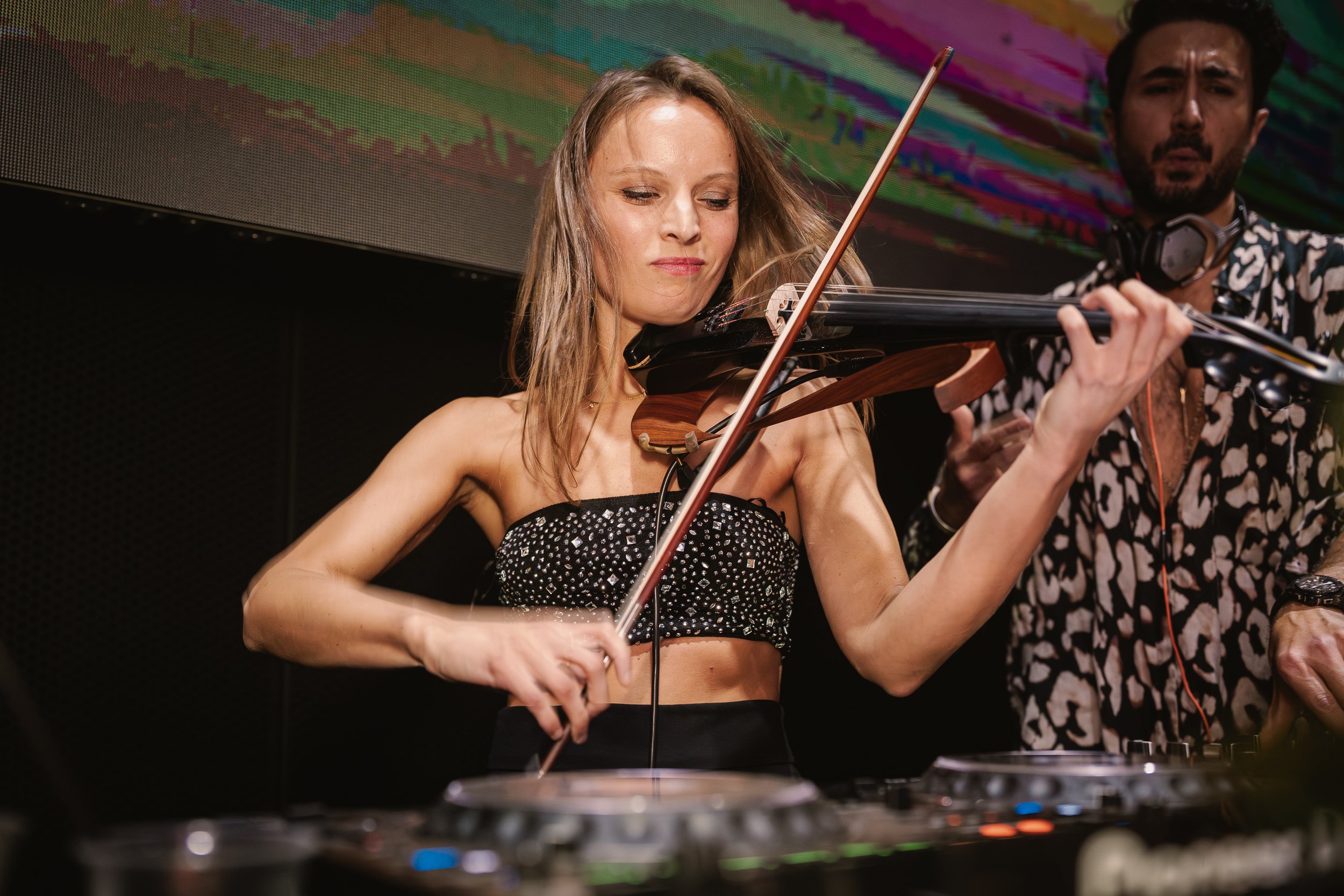
His view is simple: let those who want to share, share. It normalises the experience. The resulting photo albums are themselves works of art, not just in service of memory but as artistic statements in their own right. They support performers’ careers and allow distant followers to glimpse the atmosphere. They also become a visual archive of the community’s evolution: images circulate among artists and future collaborators, inspiring new acts and giving courage to those unsure about attending. In this way, photography isn’t just documentation but part of the connective tissue of the events—an ongoing conversation between presence, memory, and possibility.
Chaos, Control, and Utopian Dreams
The paradox at the heart of Fox & Badge is balance. The nights are meticulously planned yet open to improvisation. Lighting rigs go up, and entire rooms are staged to feel like saloons, deserts, or temples. Alex explains that the aim is to design it like theatre without rehearsals, using club lighting. Stages are built to measure, props brought in, and backdrops are created from scratch, and every cable and spotlight must be aligned with the theme. It is like mounting a theatre production in a matter of hours—but instead of scripted actors, you unleash a thousand guests.
The effort is immense. Trucks and cars deliver equipment throughout the morning, rigging takes hours, volunteers swarm, spreadsheets groan. For a few short hours, the work dissolves into ecstasy. Then a few hours later, it is dismantled, gone, a memory made flesh only in the bodies that inhabited it.
And yet, despite the euphoria, running Fox & Badge is as precarious as any other leisure business. Ticket sales fluctuate, costs balloon, and the dream of a full-scale festival hovers just out of reach. Alex admits that he would love to do a weekend, to go really deep, but that the financial risk is terrifying. Sustainability, not megalomania, is the goal. Still, the influence of Burning Man lingers: the producer-versus-consumer ethos, the utopian impulse, the belief that everyone can contribute. Lauren explains that this is what truly matters when you come to a Fox&Badge event, all they really ask for is effort: the costume you bring, the dance you give yourself to, the willingness to step fully in. That is what transforms attendance from passive consumption into genuine contribution.
This is why Fox & Badge is more than an event; it is never something you attend just to consume.
You come to connect, to take part, to bring yourself into the mix. Everyone really is part of the event. It is also a network of collaborators. Lighting designers, aerialists, musicians, costume makers, welfare organisers—many begin as guests and return as contributors. Alex and Lauren talk about this as an ecosystem: everyone finds their corner, their talent, their offering. That is why it feels alive. They are not importing entertainment—they are growing it together.
Each night also pushes a little further. At Vikings, the costuming reached an astonishing level of coherence. Celtic Spring took the celebrations outdoors for the first time, with live music woven into the ritual. Mad Max brought vehicles onto the site, complete with a flaming guitar. Alex reflects that they are always adding, always experimenting, and always moving forward with everyone who takes part. He laughs that perhaps it comes from having a strong inner critic, but he embraces that drive. Failures, he says, are treated with compassion, never bitterness—each one a step toward the next experiment.
The Moment It All Comes Together
Ask them their favourite moment and both hesitate, torn between the opening thrill, the peak energy, and the exhausted sunrise. Lauren describes her own as that last surge when the crew finally joins the dancefloor. Everyone equal, everyone together. To Alex it is a real honour and privilege to be doing this work.
Fox & Badge is not a play party in the kink sense - there is no expectation of sexual activity on site, and that distinction is important. The kink community also needs spaces where people can
gather, feel safe, and express themselves without pressure to play. It is not a rave, not a theatre show, It is all of these and none. It is immersion, permission, transformation. It is the reminder that adulthood need not mean abandoning play - that to dance, to costume, to risk joy, is not distraction but a way of becoming whole again.
Alex summarises it simply: they are not there to deny permission, but to give it. For him, Fox&Badge is a living reminder that joy, risk, and imagination are not distractions from life but the very things that make it worth living.